
Dam it; Beavers to the Rescue
Episode 2 | 25m 52sVideo has Audio Description
Beavers are nature’s engineers who are reviving areas of the drought-stricken West.
There were once 400 million beavers in North America until trapping nearly wiped them out. Miles O’Brien travels from a Wyoming ranch to a Minnesota lab tracing the rebound of these industrious rodents. Rancher Tom Chant is a “beaver believer” after seeing his dry and dusty creek turn lush once beaver dams moved in, proving nature’s original engineers may be the West’s best hope against drought.
See all videos with Audio DescriptionADProblems playing video? | Closed Captioning Feedback
Problems playing video? | Closed Captioning Feedback
Made possible in part by support provided by Sue Hart-Wadley and Searle Wadley with additional support from Jerry Cox.
Dam it; Beavers to the Rescue
Episode 2 | 25m 52sVideo has Audio Description
There were once 400 million beavers in North America until trapping nearly wiped them out. Miles O’Brien travels from a Wyoming ranch to a Minnesota lab tracing the rebound of these industrious rodents. Rancher Tom Chant is a “beaver believer” after seeing his dry and dusty creek turn lush once beaver dams moved in, proving nature’s original engineers may be the West’s best hope against drought.
See all videos with Audio DescriptionADProblems playing video? | Closed Captioning Feedback
Where to Watch Resolve to Solve with Miles O'Brien
Resolve to Solve with Miles O'Brien is available to stream on pbs.org and the PBS app.
Providing Support for PBS.org
Learn Moreabout PBS online sponsorship♪ ♪ ♪ ♪ MILES O'BRIEN: For almost every problem you can imagine, like the hole in this dam, nature has an elegant solution.
♪ ♪ We humans, with all of our hubris, often overlook this, much to our detriment.
These are North American beavers-- Castor canadensis, if you're into scientific formalities.
They are second only to humans as impactful landscape engineers.
♪ ♪ What if we put them to work solving some big problems, like drought, wildfires, and the future of the Colorado River basin?
♪ ♪ This is what brings me to Southern Wyoming and cattle rancher Tom Chant.
-(whistling) O'BRIEN: He's a quintessential cowboy.
Central casting could have done no better.
♪ ♪ We met on a parcel of land he leases from the federal Bureau of Land Management near Rawlins, Wyoming.
He is the sixth generation of his family to ranch these dry, windy, unforgiving hills.
When your ancestors first came here and decided, "Wow, this would be a good place to, to run a cattle ranch," they must've been pretty optimistic people, right?
Yeah.
And I think the only reason we're here is, our roots are that deep, you know?
The wind blows here a lot.
If we didn't have deep roots, we'd blow away, right?
(laughs) ♪ ♪ O'BRIEN: He and his father before him have been working this patch of land along Muddy Creek for more than 20 years.
If we were standing here 22 years ago on this day, what would it look like here?
I remember coming down here, and this would be a dust cloud when the cattle come right, right down this creek.
It, it was, there was no vegetation.
O'BRIEN: The land was trampled by overgrazing sheep.
Historically, it's been a big problem in this area.
Tell us about that.
The reason why was probably just the ease of leaving the sheep where they were.
Let the sheep work the country.
When they were out of feed, move.
And so, I, I think that's where, you know, the, the overgrazing probably came.
O'BRIEN: So, the Bureau of Land Management threw out its old playbook.
They started by improving the roads and building fences to allow more sustainable rotational grazing.
♪ ♪ And then they began building lots of small dams, just like beavers.
What happened here is a familiar story all over the arid West.
The water slowed down, pooling into ponds, and what was dust became lush-- more like a salad bowl.
No surprise to these scientists not far away.
They are gearing up to get waist-deep on a quest to better understand nature's hard-working engineers.
I'm going deep.
Going deep into the world of beavers here.
O'BRIEN: They invited me along, and I was, well, eager to join them.
Leading this happy band of beaver believers is a scientist on a mission, Emily Fairfax.
She's an ecohydrologist and a professor at the University of Minnesota.
-(laughing) FAIRFAX: We're about to go into the beaver wetlands now.
♪ ♪ O'BRIEN: We're in the Medicine Bow National Forest, and we're going into a beaver complex, which is like a huge beaver neighborhood.
(laughing) O'BRIEN: Before we began our trek, we got an advance peek, thanks to Emily's prowess as a drone pilot.
(drone whirring) ♪ ♪ So, right now I'm flying over the corridor that the beavers have dammed, and we're seeing quite a few beaver ponds.
♪ ♪ O'BRIEN: It's like this distinct path.
-Yes.
-How long does this green swath go?
-So, right now, I've flown a half a kilometer away, and it's all beaver-engineered.
We think this is just one family doing this work here, but they take little... -One family?
-One family.
-And for more than a kilometer?
-Mm-hmm.
♪ ♪ O'BRIEN: They don't call them busy for nothing.
♪ ♪ A typical beaver family consists of a mom and dad that mate for life.
They have a litter once a year, anywhere between one and six kits.
FAIRFAX: So, in a given family at a given time, you could expect there to be somewhere between six and ten beavers, with the parents, the "teenage beavers," and then the little kits.
O'BRIEN: The water cover they create is an effective defense against predators and a great way to encourage more growth of the tree bark, leaves, and plants they eat.
They can go all the way up and down this river corridor and stay in the water 95% of the time, access more food, access more building material, and generally have a bigger area to roam.
O'BRIEN: The streams here flow into the headwaters of the Colorado.
And beavers are building infrastructure that can really help out, because this is one of the most overutilized rivers in the world.
♪ ♪ Help us understand how that could help that overall system, that overtaxed system.
-So every one of these wetlands is like a speed bump for the water, delaying that water.
O'BRIEN: As climate change brings warmer temperatures, more rain, and less snow, retaining water here becomes even more essential.
These wetlands help store and release water gradually, sustaining downstream ecosystems as the climate becomes less predictable.
The wetlands can also help curb both the causes and effects of wildfires.
♪ ♪ REPORTER 1: The Mullen wildfire is growing.
REPORTER 2: It's nowhere close to being contained.
REPORTER 3: Strong winds have helped the fire to grow to... REPORTER 4: ...176,000 acres... O'BRIEN: In 2020, a megafire tore through this area, leaving its mark.
Dead, gray trees now stand in stark contrast to the lush, linear oasis.
During the blaze, this wetland wasn't just a refuge for beavers, but for countless other species, and long after the embers cooled, it remains a lifeline.
FAIRFAX: After a fire, what do you do in the landscape?
Like, how do you repopulate when it's this bad of a burn?
Well, we have mature pine trees here, we have mature willows, we have beavers, we have the sediment capture.
We're four years out now from the fire, and these beaver wetlands are still the hotspots of biodiversity here.
♪ ♪ O'BRIEN: Emily's intrepid fieldwork has helped open the floodgates.
All over the West, land managers are looking to enlist beavers as a force multiplier.
About 100 miles west, where rancher Tom Chant grazes his cattle, I met Scott Miller.
He is the aquatic resources program lead for the Bureau of Land Management.
He's at the center of a campaign to restore streams and rivers and the vegetation that borders them, so-called riparian zones.
70% to 80% of all wildlife in the arid West depend on them.
He showed me how they construct beaver dam analogs.
MILLER: We first drive the post into the ground.
WOMAN: Looks good!
Then we put some sod in, and then we're weaving willow and aspen branches between the, the poles.
WOMAN: Oh.
And then we're putting some more sod in.
And then we're just alternating that process until we get to the desired height of how much we want to back water up.
They can be built in anywhere from a half-hour to two hours, depending on the size and complexity.
O'BRIEN: They're building a hundred beaver dam analogs here.
And that's creating lots of groceries for beavers, so they're moving back in, sometimes using the human-built knock-offs, other times, building something much better.
Scott Miller is happy with the way things are turning out.
♪ ♪ He took me to a spectacular perch high above the Muddy Creek Valley to show off.
So when you look at this, this is, this is what you're after?
-Yes, I think it's a good picture of what we're after.
This area has healthy, functioning beaver populations.
O'BRIEN: You can't even see the streams snaking through the riparian vegetation, the way nature intends.
-If we can partner with nature and get beaver to come into the system, they take over and do what they do so well for us, and it becomes a lot more sustainable.
-So, what does a good beaver make per year?
(both laugh) Not enough-- not enough.
O'BRIEN: Those beavers have made Tom Chant's cattle very happy, but in the early days, he was skeptical.
Maybe even incredulous.
Do you recall when you first heard about the idea of kind of recreating what a beaver does in the natural world and what you thought about that?
You know, I don't know, even know if I heard about it, uh, more than I rode up this creek and I witnessed it.
And, and so that was probably, "What are these people doing?"
-(laughs) -And, fast-forward three years, you've, you watch the water table raise, you watch the vegetation fill in on the creek.
Next thing you know, you got aspen trees and willows growing.
And so, the positive impact that it made, uh, made me a believer in, in what we're doing.
(whistles) O'BRIEN: But what makes beavers such remarkable engineers?
How do they transform landscapes so effectively?
For answers, Emily Fairfax and her team frequently turn to the Saint Anthony Falls Laboratory, perched on an island in the Mississippi at the University of Minnesota.
(crowd cheering, horns and whistles blowing) Step aside, Goldy the Gopher.
There's a new rodent making waves here.
FAIRFAX: I'll work on patching the primary.
Jessie, if you want to work on the two upstream secondaries.
-Yup.
-Michelle, if you want to work on the downstream secondary.
O'BRIEN: On this day, she and her team were building a beaver dam in a miniature river called a flume.
They will use these experiments to design better beaver dam analogs.
I think we should probably run a cycle.
WOMAN: Yeah.
FAIRFAX: And see how it looks.
O'BRIEN: Give us a sense of some of the, the big questions you have in your mind when you come to a place like this.
-Yeah, so some of the biggest questions we have are about failures.
A lot of people worry that if you hit a beaver dam analog or a beaver dam with a flood, it's just going to all burst out at once and everything's going to go downstream and cause a lot of damage.
We're hitting these with ten-, hundred-, even thousand-year floods, but we're not seeing total blowouts.
O'BRIEN: Built in the mid-1930s, this lab was designed to advance human engineering efforts to keep the Mississippi River navigable and less likely to flood.
If you want to get ready to take some measurements, Jessie's behind you to write some stuff down.
O'BRIEN: Emily Fairfax is the first scientist to use the facility to try and understand beaver engineering.
What does that say about beavers in the scientific zeitgeist?
-For a long time, we just kind of ignored them, thought they weren't that powerful.
And now we're realizing, like, shoot, they're out there doing a huge amount of work and we honestly don't understand how it's happening or what it means for the rivers at different scales.
And so, we're giving them the attention they've been long overdue for.
O'BRIEN: Scientists estimate there were as many as 400 million beavers in North America before European migration.
Considered pests and valued for their pelts, they were trapped and killed to near extinction.
But they hung on.
Starting in the late 1940s, land managers tried to relocate them... FILM NARRATOR: 20 beaver, ready for the flight to Mountain Meadows.
O'BRIEN: ...in sometimes comically futile ways.
FILM NARRATOR: Now into the air, and down they swing.
The box opens, and the most unusual and novel trip ends for Mr.
Beaver.
♪ ♪ O'BRIEN: Beavers are not easy to relocate.
The whole family has to be moved together.
They're very territorial.
And in many states, it's illegal because they are considered nuisances.
But Emily has participated in a few relocations in California.
You have to move them into the places that we want them, where there's good habitat for them, and away from the places where they are absolutely not welcomed.
I think that there's a lot of work to be done on education and coexistence to get people to stop wanting the beavers to leave.
♪ ♪ O'BRIEN: All over the internet... MAN: Yeah, we need to blow some dams up.
O'BRIEN: ...and social media, you can find videos of gratuitous beaver slaughters and dam demolitions.
(explosion echoing) ♪ ♪ But Emily is not alone in her desire to change the anti-beaver narrative.
And that's what brought me to Logan, Utah, to the home of Sarah Koenigsberg.
A filmmaker turned doctoral student, she's laser-focused on nature's engineers and unsung climate warriors.
When I arrived, she was gearing up for a field trip, ready to introduce me to some beavers and their transformative handiwork.
-Onward ho to the beavs.
O'BRIEN: With her trusty sidekick, Willow, in tow, we saddled up and headed north to the Cache Valley.
♪ ♪ Simply spectacular.
A scene like this feels timeless and indelible-- yet it's changing, and fast.
So, where... -So here we are.
-This is it.
-This is the turn-off-- this is it, get ready.
Boom!
-This is Beaver Central.
Look at that.
-Check out that dam.
That dam is only about a month old.
O'BRIEN: To get a tree like that down, that's a lot of chewing, isn't it?
-It only takes them a couple of hours.
-Wow.
-I, I lucked out.
I've only one time caught a beaver's going from start to finish taking down a tree on a trail camera.
-Uh-huh.
It was between, like, 11:00 p.m.
and 3:00 a.m., and it was down.
-Wow.
♪ ♪ O'BRIEN: Chew on that idea for a moment: beavers are not to be underestimated.
As they reshape the land, they're steering the West back to the future, restoring landscapes to what they were before these industrious rodents were nearly wiped out for their pelts centuries ago.
There weren't cameras back then, when the trappers came through.
And so our baseline of our starting point of thinking-- this must be what it's supposed to be-- it actually was already a couple of hundred years degraded.
It was kind of just this, like, sea change of recognizing what these riparian corridors should look like.
O'BRIEN: By now, I was eager to lay eyes on a beaver in the wild.
Naturally, Sarah knew just the spot.
We hiked a bit farther to a pond where beavers are often active at dusk.
Then we hunkered down and waited.
And waited.
And waited some more.
(whispering): So now we just, we just sit and wait?
-(whispering): Yep.
Okay, there he is, there he is.
O'BRIEN: A few hours later, just as the last light faded, I caught a glimpse.
♪ ♪ It was fleeting, but also thrilling.
KOENIGSBERG: Look at that, it has a branch.
♪ ♪ O'BRIEN: Sarah's beaver odyssey began in 2013, when she directed and produced a film called "The Beaver Believers."
The documentary became a project that never ended.
Beavers are now her life mission.
-Bobby!
Bobby!
(bells tolling) O'BRIEN: Emily Fairfax has a similar story to tell.
Over coffee in Laramie, she gave me a backstory with an explosive twist.
How on earth did you get so interested in beavers?
I always loved wetlands when I was a kid.
And they were the coolest thing.
I was obsessed with them.
I didn't think there were any jobs in wetlands.
So I went to college and studied physics and chemistry.
O'BRIEN: She used her degree to land a job at the Los Alamos National Laboratory.
She worked on the team that maintains the nuclear weapons stockpile.
Wasn't really feeling that job.
Uh, it paid the student loans, but it wasn't necessarily my life's calling.
So I was feeling a little sad and sitting on my couch watching TV, and a documentary called "Leave It to Beavers" came on.
(theme playing) O'BRIEN: "Leave It to Beavers" was an episode of the PBS program "Nature" that aired in 2014.
(bellows) FAIRFAX: They are just showing all of these images of beaver dams in the desert, and everything is super-dry, except in the beaver pond.
And it's super-green and lush, and everything's alive.
And they were saying, "Especially as climate is changing, "there's so much we don't know about this animal, and we need more people to study this."
And I'm immediately hooked.
And, like, after a month of thinking nonstop about beavers, I decided to follow my passion and study beavers, because it felt hopeful, when everything else about climate change felt really, really grim.
That moment on the couch.
-Yeah.
How pivotal was that in your life?
-Looking back at it now, if I hadn't been feeling mopey and decided to watch TV on my couch, I may never have seen it.
I may never have thought about beavers.
♪ ♪ O'BRIEN: She took me to the place where she first started observing beavers ten years ago.
Well, what's the secret to having good balance in this situation?
-The secret to balance is... Field training is mostly doing yoga and one-leg poses so that you're good holding still when you're unsteady until you regain your composure and can take another step.
-Ah, so, downward dog means upward beaver.
-Exactly.
O'BRIEN: We were in Colorado, near Boulder, in a place called Left Hand Canyon.
It was time to get below the surface.
One by the lodge, one by the dam, one in the middle?
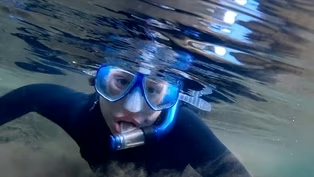
(Fairfax responding) O'BRIEN: Team member Nevé Baker suited up for some chilly snorkeling.
-(bleep) freezing!
-Is it... -Sorry.
Freezing, very cold.
(both laugh) O'BRIEN: Breathtaking in more ways than one.
♪ ♪ -It's magical down there.
♪ ♪ There are these, like, delicate canals that they've dug out where... They wouldn't exist if the beavers weren't actively maintaining them.
♪ ♪ O'BRIEN: The pond is filled with trout.
The fish that have evolved with beavers thrive in this environment and have no problem making their way through beaver dams.
Beavers create a ripple effect throughout the forest ecosystem.
The wetlands they build sustain a diverse array of wildlife, and their generosity doesn't stop there.
They often offer hospitality to other animals seeking shelter from the cold.
As Emily explained, there's a reason they are called "lodges."
They're more than just homes, they're havens.
The beavers want to have sort of a moat all the way around the beaver lodge.
The entrances are usually underwater.
And that first big chamber is usually where the beavers are going to eat their food, it's where they're going to groom each other, it's where they're going to hang out.
But sometimes they have a little tunnel and then another big chamber, and then that would be where they sleep.
The walls are usually actually one- to three-feet-thick on these.
So it's very, very insulated structures.
O'BRIEN: Come winter, you can see just how cozy it gets with a thermal camera.
FAIRFAX: And if it's full of all those beavers sleeping in their snuggle pile, the lodge might be sitting at 50, 60, even 70 degrees Fahrenheit when the rest of the landscape is, like, 30.
What you get is muskrats coming in, mice coming in, snakes coming in, frogs coming in-- everyone's coming in.
The beaver doesn't necessarily want to share its space.
So sometimes they'll make more rooms.
O'BRIEN: Let's say it got good reviews on Airbnb... -Mm-hmm.
-...and you had a lot of... -Yeah.
-...you had a lot of visitors.
How many rooms might there be?
If this was a top stop on Airbnbeave... -(laughs) -...then, inside, you could have, you know, four or five extra rooms with little visitors inside, but the beavers are going to maintain their space for themselves, and give everyone else their own little rooms.
O'BRIEN: Trekking through wetlands and building dollhouse-scale beaver dams are fun highlights, but the foundation of Emily's work happens here in her office in Minneapolis.
She and her team use satellite imagery and a computer model to determine where beavers are thriving and where they might be needed to improve the landscape.
FAIRFAX: What parts of this watershed, then, would be targets for vegetation restoration?
O'BRIEN: The overarching goal is to create a beaver census for North America to get a real handle on the size of the beaver nation and its potential impact as a climate change solution.
♪ ♪ Were you surprised at the number of beaver dams that are out there?
FAIRFAX: Oh, totally.
They are in abundance in some places.
A lot of people have this idea that beavers are gonna take over and they're gonna destroy a lot, but beavers are out there doing a huge amount of work and we don't even take notice.
You're making a nation of beaver believers, right?
Is that the goal?
(both laugh) I want a very beaver-literate nation... -Yeah.
-...that decides on their own that they believe.
O'BRIEN: Back in Wyoming, you can count rancher Tom Chant in.
He is part of a new generation of Western cattle ranchers taking a more sustainable approach.
Your fellow ranchers, do they agree or are they skeptical of this?
Any of them that, that potentially are on the fence, uh, they must not like grass, right?
We're shading the creek, we're cooling the water temperature.
Cows are happier when they got a cold drink of water at 90 degrees, right?
O'BRIEN: Not far away, Scott Miller and his team with the Bureau of Land Management are building yet another beaver dam analog.
In some quarters, the tide is turning in favor of beavers, and yet there are still stubborn pockets of pushback.
But why?
At the coffee shop in Laramie, Emily Fairfax shared her theory.
I think personally, a lot of that pushback comes from people having a hard time giving up control of the land.
For so long, we have micromanaged every aspect of the land that we live on, and if we don't have an engineering plan that's got five years' worth of projections, like, we're not on board with that.
And when you let a beaver take control, they're not doing blueprints.
They don't have engineering designs.
And so, that's hard for people.
But I think we can overcome it.
I think it's going to take a bit of a culture shift.
There will always be pushback.
But if we learn to trust nature and to believe it actually knows what it's doing, I think we can go a lot faster.
♪ ♪ O'BRIEN: As I left Wyoming, that point resonated with me.
Beavers can change the landscape a lot faster than humans.
♪ ♪ They're not constrained by regulations or blinded by the pursuit of financial gain.
They just go get to work.
♪ ♪ Maybe we should let them be a bigger part of the solution.
♪ ♪ ♪ ♪ ♪ ♪
PBS Nature Inspires Her Love of Beavers
Video has Closed Captions
Clip: Ep2 | 5m 42s | A PBS show inspired a career transition from working with nuclear weapons to studying beavers. (5m 42s)
Providing Support for PBS.org
Learn Moreabout PBS online sponsorship New Episode
- Science and Nature

Explore scientific discoveries on television's most acclaimed science documentary series.




 New Episode






Support for PBS provided by:
Made possible in part by support provided by Sue Hart-Wadley and Searle Wadley with additional support from Jerry Cox.