
June 5, 2026 - PBS News Hour full episode
6/5/2026 | 57m 46sVideo has Closed Captions
June 5, 2026 - PBS News Hour full episode
June 5, 2026 - PBS News Hour full episode
Problems playing video? | Closed Captioning Feedback
Problems playing video? | Closed Captioning Feedback
Major corporate funding for the PBS News Hour is provided by BDO, BNSF, Consumer Cellular, American Cruise Lines, and Raymond James. Funding for the PBS NewsHour Weekend is provided by...
June 5, 2026 - PBS News Hour full episode
6/5/2026 | 57m 46sVideo has Closed Captions
June 5, 2026 - PBS News Hour full episode
Problems playing video? | Closed Captioning Feedback
How to Watch PBS News Hour
PBS News Hour is available to stream on pbs.org and the free PBS App, available on iPhone, Apple TV, Android TV, Android smartphones, Amazon Fire TV, Amazon Fire Tablet, Roku, Samsung Smart TV, LG TV, and Vizio.
Providing Support for PBS.org
Learn Moreabout PBS online sponsorshipGood evening.
I'm Amna Nas and I'm Jeff Bennett.
On the NewsHour tonight, the US economy makes solid job gains despite the strain from the Iran war.
But energy executives warn the longerterm outlook is growing dimmer with the Straight of Hormuz still mostly closed and oil supplies dwindling.
And Russia's Vladimir Putin rejects Ukraine's call for face-to-face talks, where that leaves US efforts to end the four-year long war.
Major funding for the PBS NewsHour has been provided by the William and Flora Hullet Foundation.
For more than 50 years, advancing ideas and supporting institutions to promote a better world at hwlet.org.
Friends of the NewsHour, including Jim and Nancy Bner and the Robert and Virginia Schiller Foundation, the Judy and Peter Bloom Coobler Foundation, upholding freedom by strengthening democracies at home and abroad.
And with the ongoing support of these individuals and institutions and friends of the NewsHour program was made possible by the contributions to your PBS station from viewers like you.
Thank you.
Welcome to the NewsHour.
There was surprising strength in the latest jobs report.
Employers added 172,000 jobs last month, the third straight month of gains.
93,000 more jobs were added in March and April than previously estimated, and the unemployment rate stayed at 4.3%.
Overall, the labor market appears strong despite concerns about the war in Iran, rising prices, and artificial intelligence.
Kevin Hasset, the director of the White House National Economic Council, celebrated two straight months of job growth over 170.
What we're seeing is an enormous amount of positive momentum and hiring.
Obviously that you're right that a couple of 170s in a row, that's a great couple of months, but then having upward divisions of around 100,000 means that this is a a job market that's hitting on all cylinders.
For more, we're joined by Diane Swang.
She's chief economist at KPMG.
That's a multinational accounting and advisory firm.
So Diane, this was an unexpectedly positive jobs report.
How big a deal is this?
Well, one of the biggest upside surprises was in local government hiring, which increased over 50,000.
So, that was where a lot of the upside surprise was.
But, of course, we did see those upward revisions as well.
Almost all the job gains that we saw were concentrated in the service sector.
And I think it's important to look at what's under the hood is even as good as those numbers looked, we still saw very elevated numbers of what we call the undermployed, those having to take part-time instead of full-time work or discouraged workers.
And the duration of unemployment continued to rise.
And those largest gains, as you mentioned, in leisure and hospitality, help us understand what's fueling that.
Well, what we're seeing is the top third of uh wage earners are seeing their wages pick up much more than inflation and they're spending it along with the upcoming World Cup and preparations for that in host cities.
That has caused the biggest hiring in that sector since January of 2023 in the month of May.
The problem is that's adding heat to already sticky service sector inflation.
And the problem is that most Americans, the bottom twothirds of the income strata, they're seeing their wages erode and fall below the level of inflation.
We're expected to see inflation above 4.2% next week when the CPI for May comes out.
And that erosion in purchasing power is sort of where you see the disconnect between how consumers feel about the economy because they feel as though they're losing ground even though a minority of consumers are carrying spending gains and actually contributing to that service sector inflation.
I want to ask you more about that wage growth in just a moment too.
But again, big picture here, those 172,000 jobs, that beat the prediction of most economists, including yourself.
You predicted about 110,000.
You described the labor market as frozen or in purgatory.
You weren't alone in that assessment.
So, does all of this say to you there's been an unfreezing here.
There is some thaw, but there still is that undercurrent that I mentioned, and that is something that I worry about.
the quit rate at the end of April from the job opening and labor turnover survey which we watched very carefully that actually fell to its lowest level since August of 2020 in late April.
We just got that data out this week as well and that tells us that con basically workers are worried about quitting their job and we know that the premium to hop jobs also narrowed in the month of May.
So that means their opportunities to leave the job they have are less than they once were and at a very low rate.
So we're still in this we're seeing a higher hire rate than we have and that's great and we're not seeing a big fire rate.
That's also important.
But there is this sense where those who have a job are clinging on and those who want a job are still trying to get their foot in the door.
the kinds of jobs we're generating are not lowering the unemployment rate for new college grads, which is running at levels that are more consistent with the early 2010s than coming out of the pandemic.
So Diane, there's a big question here about what all this means for interest rates, right?
We're watching closely as the president's picked to lead the Federal Reserve.
That's Kevin Worsh is in the early weeks at the helm of the Fed.
They meet again in about two weeks and we know Worsh has been under pressure by the president to lower interest rates based on all the data and evidence we see now.
What do you think will happen when it comes to those interest rates?
Well, we've been arguing for some time that the Fed would have to hike, not lower rates again, and that has now become the consensus within the leadership of the Fed before Kevin Wars joined.
And I think that's very important.
We've heard some president pre presidents even talk about the need for a rate hike soon rather than later.
And I think that's important.
So what we're coming into is financial markets waking up to the fact that inflation is the most regressive of taxes out there.
It spurs inequality and you cannot sustain or attain full employment and have a more healing labor market where all boats rise with the tide unless you derail inflation.
That's why it's so critical that the Federal Reserve derails the inflation that has become entrenched and compounded over the course of 5 years, making the level of prices too high for far too many.
And D, I have couple of seconds left, but I have to ask you, there was a lot of concern after President Trump fired the head of the Bureau of Labor Statistics about whether or not numbers could be trusted moving forward.
Is there any reason to doubt the data that we've seen today?
The data is as good as it can be at this point in time and I think that's the important thing.
These are bureaucrats.
They have worked on this data for a long time.
I will note though we have the level of employment in the federal sector is now at its lowest level since 1966.
And due to the firings and retirements and quits that we saw last year, we've lost 350,000 workers in the federal agencies since October 2024. that has left staffing shortages which makes it harder to do the quality that we want from the statistical agencies.
That is Diane Swank, chief economist at KPMG.
Thank you so much Diane.
Good to talk to you.
Thank you.
As US Iran talks show little sign of progress, commercial traffic through the straight of Hormuz remains sharply reduced, raising concerns about global energy markets and supply chains.
For more on what a prolonged disruption might mean, we're joined now by Daniel Jurgen, vice chairman of S&P Global and one of the world's leading energy analysts.
Thanks for being here.
Thank you.
You have said that markets have absorbed this shock better than many expected.
What's the biggest reason why?
Well, there basically the big biggest reason why is inventories.
Inventories in the United States.
Remember now the US is the world's largest oil producer and so we have that's and the other surprise has been China which is also has built up huge inventories and I think those are the reasons that this shock has not been as extreme for the world as might have been expected on March 4th when Iran shut down the straight of Hormuse.
When those inventories deplete, how quickly could we see prices spike even higher?
Well, right now I'd say the view is that as we get into July, if there's not some relief is when you'll start to see the prices reverse from where they are.
I should say it's an it's in Asia, it's an energy crisis now.
I mean, they're really feeling it because they were so dependent on the supplies from the straight of Hormuz.
So, they're having rationing shortages.
They don't have fertilizer.
They don't have diesel for farming.
The United States, we're seeing it at the gasoline pump.
And in Europe, it's it's actually about jet fuel right now.
Well, that's right.
Right.
I mean, the consequences extend far beyond oil.
What's the most overlooked impact of this disruption?
What what are what are the other knock-on fact knock-on effects that we're not yet fully grasping?
I think the number one is fertilizer because the Gulf was a source of one-third of the world's traded fertilizer.
And this is hit during planty season in many parts of the world.
It's either driven up prices or it simply isn't there.
So, I'd put that as number one.
And here in the US, how close are we to a 1970s style energy crisis?
I don't think we're uh that close to it because we are the world's largest producer and so forth.
And I think lessons have been learned that part of the problems of the energy crisis 1970s were self-inflicted by government policies that actually created shortages where there weren't necessarily shortages.
Lessons learned.
I mean, has the fact that America is now this major energy producer, as you point out, has that fundamentally changed the the country's vulnerability to to global conflicts?
I think it's it's not changed it because at the end of the day, it's one global oil market, but it's given us insulation and it's made the United States such a dominant player that we we were not before.
So, that's such a dramatic change from previous crises.
As we've covered on this program, a swift reopening of the straight does not necessarily mean a swift return to normal.
At day 100, how much longer do you estimate recovery would take if the straight reopened tomorrow?
I think you use the right word.
It's not going to be a swift recovery.
We estimate at SS S&P that it would take uh as much as 6 months to get back to 80% of where we were before.
You got to get tankers out of the Gulf.
You got to get new tankers in.
And uh there's we think a lot of extensive damage and you have to begin production again.
So it isn't like you do a light switch and we're we're back to normal.
What are you watching for as this progresses?
I'm watching what happens with inventories is I think the the number one thing.
And obviously what is the state of the negotiation?
Is there a deal or not a deal?
And it keeps coming into focus and then going out again.
And Iran is really determined I think not to give up control of the strait.
They want to turn what was a an open uh free navigation international waterway into an Iranian canal and that's not acceptable to the Arab producers and it's really not acceptable for the world economy.
You mentioned that the lessons were learned after the 1970s with failed government policy.
When you look at a state like California that has gas prices right now an average of $6 and up, you could argue that California's interventions have put it in a worse position than other states.
Is that a preview of what heavy-handed policy responses could look like globally?
Well, I think you said it uh very clearly uh exactly because they put such pressure on their refining system.
They've forced down production in the in the state.
And so what are they doing?
They're importing gasoline from Korea.
that's made out of uh oil from the Middle East and they've created their own form of of dependence.
So California of all the parts of the country is the is the part of the country that is actually most integrated into the global oil market.
Daniel Jurgen always learns so much when you're here.
Thanks as always.
Thank you.
We start today's other headlines on Capitol Hill where Senate Republicans passed a $70 billion bill to fund several immigration enforcement agencies for the rest of President Trump's term.
This bill, as amended, is passed.
The pre-dawn vote capped a marathon 18-hour session and ended a monthsl long Democratic blockade of funding for both ICE and Customs and Border Protection.
The measure now heads to the House.
Republicans ultimately passed the bill without adopting a proposal to block the $1.8 billion settlement fund for Trump allies who say they were politically persecuted.
The final package also omitted $1 billion requested for White House security upgrades and President Trump's proposed White House ballroom.
The Senate also failed to renew a government surveillance authority with just one week until it expires.
The hangup over what's known as the FISA section 702 is because of senator's concerns about Bill Py, President Trump's pick to oversee the nation's intelligence agencies.
And on that front, President Trump says he wants PY to cut staffing even further within the Office of the Director of National Intelligence.
I wouldn't mind.
I've heard that's way too high for way too long.
Yeah, I wouldn't mind.
If he got, I wouldn't mind that.
Speaking aboard Air Force One, Mr.
Trump called PY very good and very talented.
The nomination has drawn scrutiny from lawmakers because PY, a federal housing finance regulator, lacks a national security background.
A federal judge today struck struck down the Trump administration's sweeping freeze of immigration processing for people from 39 countries.
That included things like asylum claims, work permits, and green cards.
The Trump administration moved to pause such claims last November following the killings of two National Guard members in Washington DC by an Afghan national.
Today, the court ruled that the administration ignored the law and left immigrants in legal limbo in a manner that was arbitrary and capricious.
Turning now to the Middle East, fighting between Israel and Hezbollah showed little sign of stopping today.
Israel unleashed more air strikes across southern Lebanon and ordered thousands of residents there to flee.
Rockets stre across the sky as fighting intensified.
Lebanese media reported at least nine people were killed.
Israel issued new evacuation warnings for several villages, including some sheltering hundreds of displaced families.
The escalation comes one day after Hezbollah rejected the latest US brokered ceasefire proposal.
In northern Israel, where residents have endured months of crossber attacks, some expressed skepticism that any ceasefire would hold.
I'm 23, about to be 24 years old.
about the study here in the area and they tell us time and time again that there is a ceasefire but we keep seeing that it doesn't hold and doesn't exist like a ceasefire here means nothing.
Israeli troops have now seized about a fifth of Lebanon.
It's their farthest advanced advance into the country in decades.
Iran's foreign minister reiterated today that the US war with Iran will only end when the war in Lebanon does.
The Lebanese president responded, telling CNN that Tyrron was using his country as a bargaining chip.
An air leak aboard the International Space Station prompted five astronauts to take shelter in their spacecraft and prepare for a potential evacuation.
Crew Dragon established safe haven.
And if we need to suit up, we will do that once uh we're inside the Dragon.
NASA later lifted the shelter order and told the astronauts they could return while Russian crew mates examined and work to fix the leak on the Russian side of the station.
That part of the ISS has suffered from cracks and leaks over the years.
A NASA spokesperson said today's decision was made out of an abundance of caution.
Three remaining 60 minutes correspondents told their colleagues today that they will stay with the program.
Leslie Stall, Bill Whitaker, and John Worerime wrote in a memo that they quote don't want to see 60 Minutes die and will remain to try and repair and preserve the show's reputation.
60 Minutes has been thrown into turmoil with CBS News editor-inchief Barry Weiss overseeing the recent firings of the show's executive producer as well as correspondents Sharon Alfonsa, Cecilia Vega, and Scott P. And despite today's strong jobs numbers, stocks plummeted and Wall Street suffered its worst day since October.
The Dow Jones Industrial Average dropped by nearly 700 points.
Worries of an interest rate hike rattled tech stocks and sent the Nasdaq into a 4% freefall.
And the S&P 500 finished with its first losing week in the last 10 weeks.
Still to come on the NewsHour, an art exhibit shines a light on the role women have played in shaping technologies that power modern life.
and David Brooks and Jonathan Kart weigh in on the week's news.
This is the PBS NewsHour from the David M. Rubenstein studio at Weta in Washington, headquarters of PBS News.
Tonight, Ukraine's President Vladimir Zalinski is accusing Russia of choosing war over peace after Russian President Vladimir Putin rejected his request for an in-person meeting.
Putin spoke at the annual economic forum in St.
Petersburg, a city on edge after several Ukrainian air strikes earlier this week.
Nick Shiffron reports.
Today at Russia's premier economic forum to an audience of Russia's richest businessmen and diplomats from the global south, President Vladimir Putin said a meeting with Ukraine was off the table.
I said there is no point in meeting.
The only purpose for the Ukrainian side would be to stop the advance of our armed forces.
That's all.
Yesterday, Ukrainian President Vladimir Zalinski wrote Putin an open letter.
Quote, "We see that the United States is fully focused on the issue of Iran.
Ukraine proposes ending this war through direct engagement between us and you."
But he also taunted Putin, writing, "You are fully dependent on China, and you too will have to fight much harder for your own existence.
Not Russia's, but your own."
Today, Putin called the letter Borish.
That letter was truly insolent in tone.
What is the point of that?
Is it a way to create the conditions for in-person meetings and negotiations?
Or is it a way to create an atmosphere where holding any such meetings becomes effectively impossible?
I believe it is the latter.
But the atmosphere in St.
Petersburg before the forum was created by Ukrainian drones.
On Wednesday, Ukrainian drones flew more than 600 miles to reach Putin's hometown and target an oil depot.
The blast became the backdrop to some of Russia's most iconic buildings and to the commutes of St.
Petersburg residents.
If it wasn't obvious already, the war in Ukraine has come home to Russia.
Ukrainian drones also targeted a nearby Navy base and collapsed part of a warship with guided missiles.
Today, Putin acknowledged Ukraine's attacks, but insisted Russia is still open for business.
When the investors make an investment decision, they evaluate the risks in total.
We must strengthen our security, strengthen anti-missile defense and air defense, and we will do so.
He wants to showcase Russia as a country that you want to invest in.
And yet, if you see all these other things going on, you have to wonder what it means to invest in a country which is being hit by Ukrainian drones.
Angela Stent is a senior fellow at the American Enterprise Institute and the former National Intelligence Officer for Russia and Eurasia.
She calls Zalinski's letter an attempt once again to expose that Putin has no interest in a meeting.
Putin's line on this has always been, "I'm not going to meet Zalinski until we've signed all the agreements."
And the subtext is until Donald Trump has persuaded Zalinski to give up all these terri this territory.
So, we really haven't gotten any further uh in in towards a negotiation.
A point reiterated tonight by Zilinski.
Unfortunately, the Russian side has once again chosen war.
He doesn't want to change anything.
He doesn't want to admit that his war pleases only him and only those who profit from it.
Ukraine has seized this war's momentum with long range strikes that have interrupted as much as a quarter of Russian oil refining.
And for the first time since 2023, Ukraine is seizing more territory on the front than it's losing.
But Putin today indicated he wanted Russian soldiers in Ukraine to quote work.
An indication he will continue to wage war.
This is Putin signaling that he believes that Russia can still prevail.
And the Ukrainians are certainly they have momentum both with all the drone strikes um and the fact that they've been taking back territory from the Russians.
So they are doing better, but they haven't won yet either.
And this could be still go on for a very long time.
A long war already with no end in sight and no Russian willingness to negotiate.
For the PBS NewsHour, I'm Nick.
Now to discuss Republican defiance of President Trump, fresh scandals in a key Senate race, and much more, we turn to Brooks and Kapart.
That's the Atlantics.
David Brooks and Jonathan K part of MS Now.
Good to see you both.
Good to see you.
We saw something this week from Republicans we haven't really seen much of yet.
It's fair to say it's a willingness to break with and defy President Trump.
We saw it with the $ 1.8 billion anti-weaponization fund.
Several lawmakers opposed it.
The acting attorney general said it's not moving forward.
We saw it with opposition to the billion dollars for the White House ballroom that was pulled from a spending package.
And we saw it with the War Powers Resolution for Iran.
four Republicans joined Democrats to pass that in the House.
Jonathan, is this is this a trend?
Is it a shift?
Is just a series of events that aren't related at all?
Um there are series of events, but what I'm wondering is will there be more events that allows the what's being called the Yolo Caucus to um flex its muscles?
I mean, it's amazing h what happens to the spine when you lose your primary race because the president of your own party supported someone against you.
And I'm thinking of um I'm thinking of Senator Cassidy.
I'm thinking of Senator Cornin who were both defeated in the primaries.
And you see Republicans, congressional Republicans finally deciding, you know what, I've got to push back simply because what he's doing is wrong.
but also um I want to get a little bit of revenge.
David, how are you looking at it?
Yeah, I once had a vacation in BISE and there was an earthquake off the coast and I'm running around saying there's going to be a tsunami and there's going to be a tsunami and when the tsunami came it was 2 in.
So that's the kind of tsunami we're seeing among a two-in tsunami from Republicans, only four of them.
But it's a good sign and it's a good sign for a couple reasons.
One, people who work in the capital building should be not wanting to give 1.8 8 billion to people who store in the capital.
Like that seems like basic self-interest, but mostly it's them standing up for the their branch of government in each of these cases.
The spending of the money, the war powers resolution, the ballroom.
Uh Congress does stand for something and it's been dormant for most of the Trump term.
And so at least there's a sign that we are a co-equal branch and we will stand up for our rights.
And that's got to be it's not going to be left right.
It's just like stand up for your your form of democracy.
To be fair, they could have done this at any point earlier, right?
So, is this now a shift into general election mode or into this next phase of this lame duck session of President Trump's presidency?
The magic number is 37 or whatever Trump's approval is.
Right now, it gets a lot easier as the numbers go down.
Then courage and integrity somehow rise.
Well, it also helps that um again, you saw some Republicans lose their primaries to Trump back candidates.
So, that strengthens the resolve.
But then you have the primary calendar.
Pretty soon folks worrying about what Donald Trump might do to them in their in their primary races goes away and then self-preservation really kicks in.
So the tsunami that you mentioned could go from 2 in to maybe who knows but um we will see.
That's what the point I was trying to make before and that's why you're seeing some of that from Republicans in swing districts in particular.
Right.
Well, you set this up perfectly to move to the next topic when you talk about primaries.
We saw several states hold their primaries this week, but I want to talk about Maine, which is gearing up for their primary next week.
And there's new allegations now against the Democratic Senate candidate, that is Graham Platner.
We saw a New York Times report that cites several women who dated him, saying he was demeaning to women.
He drank heavily.
In the case of one woman, Lindseay Field, I hope I'm saying her name correctly, she claims that he was he was violent.
says he twisted her arm behind her back, shoved her into her room, and held the door to confine her.
Platner denies any violence.
He repeatedly references dark periods that he went through after his military service.
And he mentioned that in an interview on MS Now last night.
I firmly believe that if you believe in a transformational politics, you got to believe in the ability for people to transform.
And my journey is one of transformation.
These are things that I talk about in my past, things that I'm not proud of, but it is a past that I had to go through to get where I am today.
And I'm very proud of who I am today.
And I'm very proud of the movement that we've built up here in Maine.
Jonathan, this is a candidate who's now had to explain away a Nazi tattoo, um, sexing other women early in his marriage, and now this.
He's not dropping out of the race.
Should he?
You know, I think there's some Democrats uh in the Senate in particular who would love for him to step aside.
Um the story in the Washington Post um today about how, you know, he'd been telling folk Democrats, don't worry.
When the Nazi tattoo thing came out, don't worry.
There there's there are no other skeletons in the closet.
And yet this past week, we've seen two big skeletons come out.
um the fact that Governor Mills only suspended her campaign, did not drop out, and telling people at least twice now, hey, I'm still on the ballot.
Signaling maybe could more things be coming and also signaling to Democrats, um, hey, if something does happen with Platner and he has to get out, I'm still here.
But the issue here is I it's not going to be congressional it's not going to be congressional Democrats, national Democrats who are going to tell Platner to get out of the race.
Folks in Maine are still behind him.
Um some of the interviews that we've had on MS Now, you've had f Mayners saying he's not perfect, he's not this, he's not that, but we need a change.
And so that's the one thing he has going for him.
And again, we have to I look at Platner through the prism of where we are in terms of the Trump administration and Trump world.
Given who Trump is, given the allegations against the president, given the way that lots lots of people in the Republican party turned a blind eye and decided we still want to vote for this guy.
And so I think there might be there are a lot of Mayers who are thinking the same thing that he is their guy.
But the one last thing that, you know, everyone in Maine has to worry about is Senator Susan Collins.
I mean, Democrats really want that seat.
But Senator Collins has shown over multiple campaigns that one, she runs like she's losing, and then on election day, she outperforms she outperforms the polls.
David, I should also note here because the woman Lindsey Field we mentioned has worked for Republican and conservative campaigns and issues in the past, some people are dismissing this as politically motivated.
How are you looking at all this?
The guy's a moral degenerate.
You know, he the the abuse of women, the sexing, the Nazi tattoo.
I don't even need to say anything beyond his Reddit posts, which are not in the past, by the way.
He he did that for a long time.
uh abusing rape people who had might have been raped, diminishing rape in the military, insulting fellow military officers, calling himself a communist.
It's just it's a pathetic empty guy who postures uh in a way that's kind of repulsive.
There are 330 million Americans and there are 100 senators.
We can't have a decent human being in those hundred.
Like, we've got to we've going to settle for this.
Uh you know, I just think the people the Democrats are supporting Platinum for the same reason the Trump people are supporting Trump.
It's because 20 or 30 or 40 or 50 years ago, we sort of privatized morality.
We told people, "We're not going to teach morality in schools.
We're you.
It's up to you to come up with your own values."
And the problem when you do that is that unless your name is Aristotle, you probably can't come up with your own moral philosophy.
And so what happens, you get a lot of people in this country, Republicans and Democrats, who are good people, but they're morally inarticulate.
They're morally undeveloped.
They haven't developed the criteria to even think about what is my role here?
What is his role?
How what is excellence defined in this role?
What is moral excellence as a journalist, as a teacher, as a senator?
And we're going to make decisions on a two-stage basis.
First, is the person we're electing to a public office a person of basic integrity?
And second, do I agree with them?
But if you haven't, if you've gotten rid of the first criteria, then you have weakened your democracy.
And Republicans clearly did that with Trump.
And now Democrats really if they if they side with Platner, I don't want to hear too much about Trump in the future and his moral degeneracy.
Jonathan, to that point, I guess it is absolutely ultimately up to the people of Maine, right?
They will vote and they will decide and have their voice enough to remember congressional Democrats pushing Al Franken out of office.
Yeah.
Right.
So, have the standards changed over time, but also based on how close they are to the election process?
Um, yes.
I think standards have changed a little bit.
And you know, David, David's moral indignation over Platner is something that I share.
Um, but I'm also looking at the fact that, well, we do have Donald Trump in the White House and that, yeah, the moral degeneracy is coming right from the top.
And I'm looking at this again through the prism of Democrats, particularly Mayers.
I don't want to put all Democrats saying that they're they're supporting Platner, but the folks in Maine have clearly decided, if you look at the latest polling, that they right now don't care about his past.
They just want to win this seat.
And to David's point, there is a cost to that.
if he does win um if he doesn't win is going to be very painful for Democrats and in the end painful for the country uh from the Democratic perspective because they're hoping that seat puts them in helps to put them in the majority.
As you mentioned, Janet Mills is still on the ballot.
So, we'll wait to see how people in Maine look at this.
Uh before I let you go, I have to ask you about something that's going to allow me to talk about Vanilla Ice and Flow right now, which is something I don't always get to do on the NewsHour, but we're less than a month away from the US 250th anniversary celebrations.
Last week, you saw most of the artists, including people like Martina McBride, Young MC, the Commodores, and Brett Michaels, dropped out of a related concert series on the National Mall.
They said they were misled by what the event was supposed to be.
and the president has said they're making it political, right?
Um Jonathan, we've had this conversation before around inauguration performers and the like.
Can you no longer separate performing for the person or performing for the nation?
I mean, how do you look at all of this?
Well, I look at it like this.
Um I love I love the Commodores, right?
Um, if the nation, say if it was America 250, which is the bipartisan outfit, came to came to me, I'm I'm a member of the Commodores, comes and says, "We want you to perform."
But, you know what?
Great.
It's America's 250th birthday.
Let's do it.
It's a nice bipartisan thing.
But instead, it was freedom 250 and that is, you know, all about the president.
And so through the confusion, I could see how the Commodores and other folks were like, "Wait, this is not this is not the same thing.
No, I don't want to be a part of that because even though we're musicians and music is universal, what this person, what his administration is doing is just not what we are about.
We don't want to be associated with it.
We don't want to be connected to it in any way."
So I don't blame them for for dropping out.
What is interesting is the question is why can't the president find performers who are willing to share the stage with him who are willing to give lend their credibilities um and their star power to him.
Well I this brings me back.
We still have FLA Vanilla Ice and I believe Lee Greenwood is now on the I am here all day for Vanilla Ice for Ice Ice Baby.
Uh uh I I learned out of this whole week that Morris Day in the time still has a career going.
People who saw the Purple Rain movie would saw Morris Day Time.
He's still going strong.
Day, you know, he was he was big back in the day.
Back in the day.
So, but so these are not it's not like Taylor Swift and Justin Bieber here.
We're getting like low-level people, but at least grade C. They're good.
They're good human beings.
I don't mean to comment on their wonderful people.
Um, you know, I guess I I see it as a the overpoliticity of everything that we can't even do a concert without politics, but b and on a slightly deeper level, one of the problems we're facing in America 250 is what's our national narrative.
If we can't agree on that, then that's a subpolitical problems that's real.
And I think at the heart of all these America 250 fights are this.
What is our national narrative?
We used to have a sort of consensus about that.
We were an exodus story.
Americans left oppression.
They crossed the wilderness and came to the promised land.
The founders wanted to put at least some of the Moses on the great city of the United States.
Every immigrant group said, "Yes, I'm an Exodus story."
Martin Luther King talked about Exodus more than the New Testament.
Almost a slight exaggeration.
But it's the idea that we are that country and people no longer believe in that narrative.
A lot of people David Brooks, Jonathan Kart, we'll pick up again another time soon.
Good to see you both.
Thank you so much.
Thank you.
Women have played a vital role in building the technologies that shape modern life.
Yet, their contributions have at times been overlooked, minimized, or left out of the historical record.
A new exhibition seeks to tell a fuller story, featuring artists from California and beyond.
It draws connections between the work performed in Silicon Valley's laboratories and the generations of labor women have carried out in factories, offices, and homes around the world.
Special correspondent Mike Sur reports from San Jose for our arts and culture series, Canvas.
The old analog clock at top the historic wing of the San Jose Museum of Art is considered to be one of the early examples of high technology here in the capital of the Silicon Valley.
It's a representation of the importance of the marriage of art and technology in our community.
Jeremiah Wilson Davis, the executive director of the San Jose Museum of Art, is trying to bridge the technology and art gap, real or imagine, with exhibits appealing to both cultures.
The idea that art and technology are divorced, I think, is a fallacy.
Art and technology have been present since the very beginning.
But that the two are not separate.
They're born from the same human impulse.
And that's why they share a root in the ancient Greek word techn.
The museum's current motherboards exhibit, titled after a computer's main circuit board and nervous system, shows how connected women and technology have been since the early days of computing and the evolution of the Silicon Valley.
Rhonda Halbertton was originally a sculptor before adopting some of the digital art tools to advance her craft.
The piece that I made for uh motherboards is partly inspired by my own familial history.
My greatgrandfather uh was both an engineer.
He also had uh orchards here in Silicon Valley and in fact before Silicon Valley was Silicon Valley.
It was known for its orchards uh as the valley of the heart's delight.
showing the sculpture itself is a plum branch which is a nod to that agricultural history.
So I've translated that plum branch from a 3D scan of an actual tree that are then 3D printed with bioplastics and resins.
Her exhibit, Collateral Influences, includes a digital representation of the plum branch in honor of the early role women played in computer technology.
Ada Love Lace is largely known as the world's first computer programmer or at least author of the first algorithm.
So on the screen on the face of the sculpture on top of the 3D model of the plum branch is a representation of Ada Lovelo's note G algorithm.
The first algorithm turned into binary code and then turned into black and white pixels.
Silicon Valley AI chipmaker Nvidia recently named one of their high performance chips after this mid9th century mathematician.
As a child, I loved problem solving.
I loved math.
I loved science.
I loved making things.
Doesn't look like anything like a computer.
Looks like an inverted couch or something.
Sarah Bakayas earned degrees in both mechanical engineering and fine arts before becoming a digital artist.
human computers who were women who did a lot of computational work before the actual physical computer.
They were humans who were computers and so their work is sort of like the mother of the computer industry.
Her digital audiovisisual collages included early technology drawings and patents filed by women.
And you can do a lot of things with physical art, but in the digital space, you can work in this three-dimensional computer program, and you can add texture to the um models, and you can move them around in certain ways, and you can collage them together in a digital space.
This physical representation of her collages with pink fur accents is called Kitchen Computer Plushy.
It was inspired by this 1969 Neman Marcus catalog ad for an early Honeywell kitchen computer, the size of today's kitchen islands with a tagline, "If she can only cook as well as Honeywell computes."
I love to use humor um in my work because it can take really challenging ideas and make them more accessible.
Um, it can also be make them amusing and there's a history in art of using humor for that.
This traditional Navajo weaving of the Pentium microchip recognizes the contributions of Navajo women's arts and craft skills to computing while they worked at Intel's chip fabrication facilities in Arizona and New Mexico.
Unlike some art forms that might stay on the computer or stay in a screen, digital weaving comes off the screen and it comes onto the wall and you have a physical wall.
Sarah Mills curated the companion woven pixel exhibition at the nearby San Jose Museum of Quilts and Textiles.
It represents how full circle a traditional art form like weaving has come because of technology.
The entire process is now computerized as much or as little as the artist wants.
The interesting thing about weaving is that you can go back and forth.
You can go from a computer to a hand loom.
And so now weavers embrace both because it is easy to work with your hands and a computer.
When not creating digital art, Rhonda Halbertton is an assistant professor of digital arts at San Jose State University, one of the first universities to combine fine arts and digital technology into a degree program.
I think the the genesis of art and technology, the integration started in places where technology is located because artists uh universities were able to play around with some of the first computers.
The growing popularity of the city's first Friday art gallery walks is testimony to how connected the tech and arts communities can be in the Silicon Valley when it comes to breaking rules and creating things.
For the PBS NewsHour, Mike Surere in San Jose, California.
And we'll be back shortly to hear from a Brooklyn chef who's making family dinners for $5.
But first, take a moment to hear from your local PBS station.
It's a chance to offer your support, which helps to keep programs like this one on the air.
For those of you staying with us, we take a second look now at a federal provision that's changing the definition of hemp.
A small tweak that could have a huge impact on the booming market.
Jeffrey Brown has our encore report from Kentucky.
Inside a 25,000 square foot facility in Louisville, adult use gummies are being churned out at Cornbread Hemp.
Supplements with flavors like blueberry and blood orange have CBD, a compound that advocates site for its therapeutic benefits, including combating anxiety, insomnia, and inflammation.
But they also include THC, which has an intoxicating effect.
Though popular confusion abounds, they're not made from marijuana, but from another variety of the same plant, hemp, and they're fully legal for now.
This is the first step.
This is a uh a supersack of um our hemp produced grown here in Kentucky.
Jim Hickden is co-founder of cornbread hemp.
Then here's our uh certificate from the Kentucky Department of Agriculture that certifies that the DHC content is well below that 0.3% standard.
that we need to make sure that this remains a federally legal product.
The 2018 Farm Bill legalized hemp after decades of prohibition because of its connection to marijuana.
In fact, the plant has been cultivated in Kentucky since the 18th century.
Hemp grows so luxurantly in Kentucky that harvesting is sometimes difficult, including during World War II when the fibers from the plant were crucial to the war effort, turned into rope, textiles, and even parachute webbing.
As for the United States Navy, every battleship requires 34,000 ft of road.
It was these types of industrial uses that advocates like then Senate Majority Leader Mitch McConnell cited in supporting hemp legalization 7 years ago.
But that also brought unexpected consequences as the popularity of CBD grew and entrepreneurs created products that extract the small amount of THC and hemp, bringing a boom in products like gummies and beverages that can get you high.
It's a surprising marketplace that people didn't realize existed.
We've recently expanded and built out our gummy production facilities because of the popularity and the projections of continued popularity of these products.
The 7-year-old company employs more than a 100 people and today legally ships its products to almost every state in the country.
But that legal future is now in jeopardy.
Unfortunately, companies have exploited a loophole in the 2018 legislation by taking legal amounts of THC from him and turning it intoxicating substances.
The senator who championed the legalization of hemp led the recent effort to change the definition of it, citing how products like gummies have been too accessible to children.
Starting in November, hemp will no longer be defined by just the amount of THC by weight in the dry hemp plant.
Instead, federal law will limit all synthetic canabonoids and the amount of THC in the final product being sold.
The goal to get intoxicating hemp products off the shelf.
What will the impact be on your company if this change?
If we can't diversify into products that do not contain any hemp, then it will mean the end of the company.
It will certainly mean the end of the every product that we currently make.
The industry does have its supporters in Washington, including Kucky's other senator.
The numbers put forward in this bill will eliminate 100% of the hemp products in our country.
But not all parts of the hemp industry are convinced this rule change is a death sentence.
We've been operating in this facility since 2018.
Chad Rosen is founder of Victory Hemp in Northern Kentucky, which turns hemp seeds into non- intoxicating protein powder and oil.
Another of the many uses of hemp.
This is not a ban on the entire hemp industry.
It clearly defines that products from industrial hemp as defined by um those grown for the grain and the fiber are not getting banned in any any fashion.
And we're not celebrating the cannabonoid sector potentially phasing extinction.
But we are happy that that that industrial hemp has gotten some real regulatory definition.
He sees a huge potential for products like his, as well as other innovative uses of industrial hemp, like using the fiber for building materials and even as a sustainable, lightweight alternative to plastic in auto manufacturing.
There's a lot of assumptions that come along with hemp.
And uh part of half of what we do is just navigating the true story.
We're constantly trying to impress on people that it's different genetics, different aronomy, different processing, different products, different consumer experience.
And so for that, the regulatory framework needs to be considered very different.
My fear is that it will drive a lot of people to go back underground to get product from their street dealers.
Dee Taylor runs a consumer hemp shop in Louisville.
She's also president of the Kentucky Hemp Association.
In 2023, the group worked with state legislators to address concerns about the products to restrict sales to those under 21 and mandate lab testing.
Rules that will now be superseded by the new federal rule change.
And I don't take any pain medicine.
She worries for her customers like Charles Wimpy.
When I go home, I'm going to be able to relax.
I'm going to be able to maintain.
I'm going be able to play with my grandkids.
all because of this.
Is a Republican who voted for Mitch McConnell, but says he's disappointed in how Congress has changed the rules.
Until they sit in somebody's seat, they'll never realize, and I'm going to tear up because this helps and people do not realize it.
It's a shame.
Is a compromise possible?
Recently, President Trump asked Congress to reconsider the recent hemp rule change, and legislation has been introduced that would accomplish that while also adding age restrictions nationwide.
But with the planting season right around the corner, the timeline for farmers here and around the country is very tight.
For the PBS NewsHour, I'm Jeffrey Brown in Kentucky.
With rising grocery prices, many Americans are struggling to provide healthy, complete meals for their families.
NewsHour digital anchor D.A.
Zayn has the story of one chef who teaches his Tik Tok followers how to eat well on a budget, one $5 meal at a time.
You should not feel ashamed because you can't afford to make a meal.
There's no shame in that.
Everybody goes through struggles.
Chef Maurice Lavine, or Chef Mo as he's known on Tik Tok, isn't your typical culinary creator.
High energy and boiling over with positivity, he specializes in creating delicious recipes on a tiny budget.
How to feed your family with $5.
And no, we aren't talking about a PB&J.
Chef Mo teaches followers how to plan, shop, and prepare meals like sausage, biscuits, and gravy, veggie alfredo, and even shephardd's pie.
Well, he dubbs it Chef Mo's pie.
But Chef Mo didn't start out as a penny pinching chef.
He launched his account last year to share cooking tips, but he soon learned some of his followers were struggling to afford basic necessities.
There was one uh message in particular of someone expressing how they thought the dish was amazing.
They couldn't wait to try it, but they had to wait till next month to buy the ingredients to make the dish.
So, I had reached back and I uh I asked what exactly do they need are they missing to make that dish.
Lavine learned that the commenters life circumstances had changed in a blink of an eye.
They didn't have certain spices, something that I take for granted, you take for granted, and we wouldn't think how somebody couldn't have salt and pepper or someone couldn't have paprika.
And that really that was my eyeopening moment that people need help.
And just like that, the Mount Pocono, Pennsylvania based chef launched a new budget conscious series on his channel, How to Feed a Family with Just$5 or $10.
And I said, "I'm going to make meals for $5."
So, I I had went out to the store.
I hit record.
I said, "Let's feed your family for a meal of $5 or less."
Our total is $4.19.
Holy, we even got change for a drink.
Chef Mo takes his viewers through stores like Dollar General, explaining why he's choosing specific items, striving for balanced nutrition and budget.
Let me see.
We got garlic and herb.
It already has the garlic in it.
has herbs in it and a sauce.
We're getting an onion, so we're building flavor.
Now in the kitchen, he details his every move to viewers, educating them on culinary techniques that add flavor to dishes on the cheap.
Good look at how much fat was rendered.
That's all flavor.
All that oily looking substance, that's fat from these sausages.
I explained how to emulsify sauces, how to bring these flavors together, how to marry them to where they sit on the pallet and you don't have to feel like it's a $5 meal.
You can actually smile and enjoy it.
After nearly a quarter century in the culinary field and eight years as a head chef, Lavine hopes to pass a dash of his expertise and intrigue about the science of cooking on to his viewers.
Instead of just showing how to make the dish, why don't we explain why we're doing this and this for the dish so that we'll build the confidence in people so they could be able to cook.
Now a full-time social media chef armed with more than 800,000 Tik Tok followers and growing.
Chef Mo hopes he can continue to help families struggling with rising food prices in an unpredictable economy.
What I think the most important thing of what I do is getting food into the bellies of people that need it.
Is helping the people that need that help that are too embarrassed or ashamed to ask for it because that's a big problem.
Food insecurity is a real thing.
And his followers appreciate the help.
Comments pour in from people around the nation.
Thankful for Chef Mo's creative approach to tasty and affordable meals.
That's how you feed a family of four for $5.
I'm not going to stop world hunger, but if I can help a few people, I I I'd be honored to.
A sentiment that is seasoned to perfection.
For PBS News, I'm D. Mazain.
As always, there's a lot more online, including a look at the consequences of President Trump's tougher work requirements for Medicaid in Nebraska.
That's at pbs.org/newshour.
And be sure to tune in to Washington Week with The Atlantic later tonight right here on PBS.
Jeffrey Goldberg and his panel discuss the so-called YOLO caucus and the political problems it's creating for President Trump.
That's tonight on Washington Week.
And be sure to watch both Horizons and Compass Points this weekend.
You can find those on our YouTube channel or wherever you get your podcasts and on your local PBS station.
Check your local listings for more.
And that is the NewsHour for tonight.
I'm Amna Nas and I'm Jeff Bennett.
For all of us here at the NewsHour, thanks for spending part of your evening with us.
Have a great weekend.
Major funding for the PBS NewsHour has been provided by the ongoing support of these individuals and institutions and friends of the NewsHour, including Kathy and Paul Anderson and Camila and George Smith.
The Walton Family Foundation, working for solutions to protect water during climate change so people and nature can thrive together.
And with the ongoing support of these individuals and institutions and friends of the NewsHour, this program was made possible by the contributions to your PBS station from viewers like you.
Thank you.
You're watching PBS.
 New
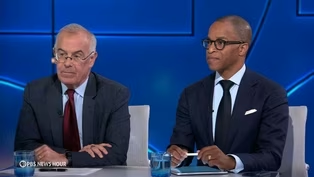
NewBrooks and Capehart on GOP lawmakers’ defiance of Trump
Video has Closed Captions
Brooks and Capehart on some Republican lawmakers’ defiance of Trump (13m 22s)
 New
NewExhibit shines light on women’s role in tech of modern life
Video has Closed Captions
Art exhibit shines light on women’s role in technologies that power modern life (6m 30s)
 New
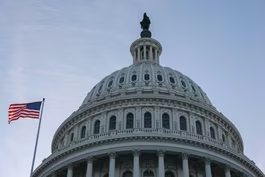
NewNews Wrap: Senate passes $70 billion immigration bill
Video has Closed Captions
News Wrap: Senate passes $70 billion immigration enforcement bill (5m 10s)
 New
NewOil supplies dwindle as Strait of Hormuz still mostly closed
Video has Closed Captions
What may happen as oil supplies dwindle and Strait of Hormuz remains mostly closed (4m 55s)
 New
NewPutin rejects Ukraine’s call for direct talks to end war
Video has Closed Captions
What Putin’s rejection of Ukraine’s call for talks means for efforts to end Russia’s war (4m 8s)
 New
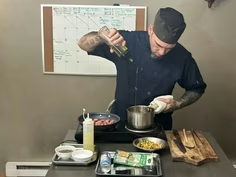
NewThis chef will teach you how to make $5 family dinners
Video has Closed Captions
This chef will teach you how to make healthy $5 family dinners (4m 35s)
 New
NewWhy hiring surged in May despite strain from the Iran war
Video has Closed Captions
Why hiring surged in May despite economic strain from the Iran war (6m 43s)
Providing Support for PBS.org
Learn Moreabout PBS online sponsorship
- News and Public Affairs

FRONTLINE is investigative journalism that questions, explains and changes our world.
 New Episode
- News and Public Affairs

Today's top journalists discuss Washington's current political events and public affairs.

 New Episode
 New Episode


 New Episode
 New Episode
 New Episode
Support for PBS provided by:
Major corporate funding for the PBS News Hour is provided by BDO, BNSF, Consumer Cellular, American Cruise Lines, and Raymond James. Funding for the PBS NewsHour Weekend is provided by...