Here and Now
Ann Jacobs on a Nationalized Voter List and Mail-in Ballots
Clip: Season 2400 Episode 2438 | 6m 15sVideo has Closed Captions
Ann Jacobs on an order to create a national voter list and restrict mail-in ballots.
Wisconsin Elections Commission Chair Ann Jacobs discusses an executive order from President Donald Trump that seeks to create a national list of eligible voters and restrict use of mail-in ballots.
Problems playing video? | Closed Captioning Feedback
Problems playing video? | Closed Captioning Feedback
Here and Now is a local public television program presented by PBS Wisconsin
Here and Now
Ann Jacobs on a Nationalized Voter List and Mail-in Ballots
Clip: Season 2400 Episode 2438 | 6m 15sVideo has Closed Captions
Wisconsin Elections Commission Chair Ann Jacobs discusses an executive order from President Donald Trump that seeks to create a national list of eligible voters and restrict use of mail-in ballots.
Problems playing video? | Closed Captioning Feedback
How to Watch Here and Now
Here and Now is available to stream on pbs.org and the free PBS App, available on iPhone, Apple TV, Android TV, Android smartphones, Amazon Fire TV, Amazon Fire Tablet, Roku, Samsung Smart TV, and Vizio.
Providing Support for PBS.org
Learn Moreabout PBS online sponsorship>> Just as Wisconsin is heading to the polls next Tuesday, calls from Washington to nationalize elections.
The executive order President Trump signed this week would create a national list of U.S.
citizens eligible to vote and restrict mail in ballots.
This order is not in effect for our April 7th election, and Democrats have filed a lawsuit over it.
But does it perpetuate mistrust in the voting process?
We turn to the chair of the Wisconsin Elections Commission.
And Jacobs, thanks very much for being here.
>> Happy to be here.
>> So what is your reaction to President Trump's executive order?
>> I think it was at best unfortunate and at worst unconstitutional.
The administration of elections is delegated by the U.S.
Constitution to the states, and Congress can make laws regulating elections.
And an executive order is neither of those things.
>> And so it's your belief that this would not be in effect for the November elections or, in effect, ever.
>> My suspicion is never in effect, ever.
It's sort of a back door way to create time limits and new administrative hurdles for voters to go through.
Under the auspices of addressing essentially what our conspiracy theories about absentee balloting.
>> So if it were to go into effect, what would the ramifications be?
In Wisconsin?
>> So in Wisconsin, by way of example, you can request an absentee ballot five days before an election and you are eligible to vote.
If you've been a resident of Wisconsin for 28 days.
So a new resident of Wisconsin could come and ask for a ballot and have the right to vote under the executive order.
However, that name and that address had to have been submitted to the US government prior to 60 days before the election.
So you create conflicts between the statutory rights under state law with this mailing deadline, and now the government's going to control whether they will even mail your ballot.
And how do you undo that?
What is the remedy if the government says, oh, you weren't on the list, so I'm not going to mail your ballot?
Ha ha.
And the reason they're not mailing it is maybe because there's a typo in a list somewhere, or you moved or what have you.
So it's really just sort of creating an unnecessary and unworkable mess.
>> In, in your mind.
Is it more possible with mail in ballots to experience voter fraud?
>> No, the short answer is no.
There's a number of checks and balances involved in addressing mail in ballots.
First of all, you got to be registered.
Being registered in Wisconsin requires a driver's license or the last four digits of your Social Security number.
If you don't have a license or ID, it has to go to your registered voter address.
If you're sending it somewhere else, we send a postcard to your registered voter address saying, hey, did you order this ballot to go somewhere else?
It requires a witness with an address to sign your absentee ballot envelope that affirms that they know you and they saw you complete this ballot.
And then when it comes in to the elections, municipal clerks across the state, they check it off, check it in, and that ballot then is tallied.
There's just a lot of checks and balances along the way.
>> This executive order also seems to be trying to get at the issue of only U.S.
citizens voting, because that is considered in in some corners, you know, rampant with with fraud.
What is your knowledge of whether that is happening here in Wisconsin?
Non-Citizens voting?
>> We actually have some numbers on that.
There are four documented cases of non-citizen voting since 2016.
During that time, 25 million ballots have been issued in the state of Wisconsin.
And if you want to do the math, it's like 0.000000 something something.
Of all ballots cast, this is quite simply not a an issue and not a problem.
Non-Citizens, generally speaking, don't want to get in trouble with the US federal government, and that's why we haven't seen really hardly any numbers of non-citizen voting.
And even those cases where non-citizens have voted many times, it's because they receive some sort of legal status that they incorrectly believed entitled them to vote.
>> Is this executive order separate, though, from the US?
DOJ suing Wisconsin to turn over redacted voter registration data?
>> Let me clarify.
They're not asking for redacted voter data.
They're looking for unredacted voter data.
They're looking for your complete name, date of birth, driver's license number and Social Security number.
That information under Wisconsin law is protected.
We don't give that out.
And that's a state law that prohibits that.
And I think we've also seen recent disclosures of I believe it was a DOGE employee who loaded the entire some sort of entire Social Security database onto a thumb drive and took it elsewhere.
Wisconsinites want their private information protected.
They don't want it going out to be shared by the government with random anti-voting entities so they can, quote, investigate non-citizen investigate non-citizen
 New
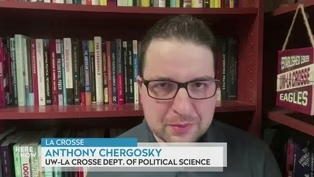
NewAnthony Chergosky on the 2026 Wisconsin Supreme Court Debate
Video has Closed Captions
Clip: S2400 Ep2438 | 5m 57s | Anthony Chergosky on the importance of a debate between Maria Lazar and Chris Taylor. (5m 57s)
 New
NewHere & Now opening for April 3, 2026
Video has Closed Captions
Clip: S2400 Ep2438 | 1m 4s | The introduction to the April 3, 2026 episode of Here & Now. (1m 4s)
 New
NewInside Wisconsin Politics: A Voting by Mail Executive Order
Video has Closed Captions
Clip: S2400 Ep2438 | 1m 45s | Inside Wisconsin Politics on an executive order calling for a national voter list. (1m 45s)
 New
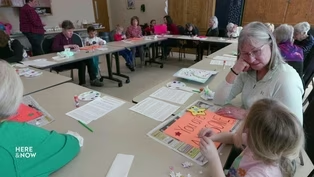
NewA Movement to Connect Generations Takes on a Crisis of Care
Video has Closed Captions
Clip: S2400 Ep2438 | 6m | Communities in Wisconsin create intergenerational care programs for adults and children. (6m)
 New
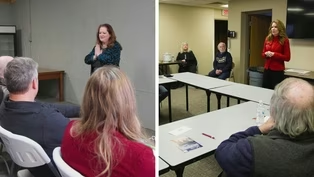
NewWisconsin's 2026 Supreme Court Candidates Get Out the Vote
Video has Closed Captions
Clip: S2400 Ep2438 | 5m 16s | Partisan efforts in the 2026 race for Wisconsin Supreme Court consider long-term control. (5m 16s)
Providing Support for PBS.org
Learn Moreabout PBS online sponsorship
- News and Public Affairs

Top journalists deliver compelling original analysis of the hour's headlines.

- News and Public Affairs

FRONTLINE is investigative journalism that questions, explains and changes our world.












Support for PBS provided by:
Here and Now is a local public television program presented by PBS Wisconsin